
4.00
(1 Rating)
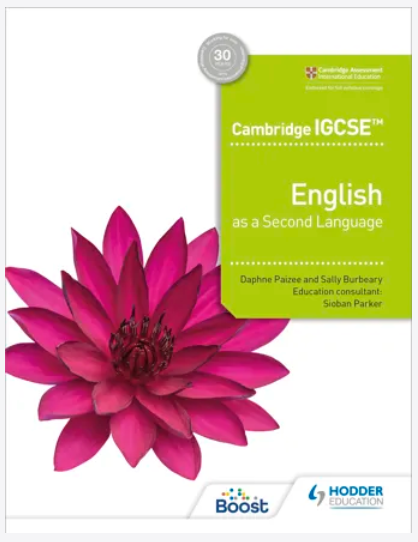
Cambridge IGCSE English as a Second Language (Speaking endorsement) (0510)
Categories: Normal Academic Tution
About Course
Syllabus overview
Cambridge IGCSE English as a Second Language is for learners who already have a working knowledge of the language.
The syllabus:
- is suitable for learners whose first language is not English, but who study through the English-medium
- develops learners’ ability to understand and use English in a range of situations
- builds learners’ awareness of the nature of language and the four language-learning skills: reading, writing, listening and speaking
- focuses on practical communication for everyday use, which can also form the basis for further, more in-depth language study
- develops transferable skills to complement other areas of the curriculum.
Marks for the speaking component in this syllabus do not contribute to the overall grade candidates receive for the written components. A count-in speaking component is offered in Cambridge IGCSE English as a Second Language (0511).
Course Content
Assessment objectives
The assessment objectives (AOs) are:
AO1 Reading
Candidates will be assessed on their ability to:
R1 demonstrate understanding of specific factual information
R2 demonstrate understanding of the connections between the ideas, opinions and attitudes
R3 identify and select details for a specific purpose
R4 demonstrate understanding of implied meaning
AO2 Writing
Candidates will be assessed on their ability to:
W1 communicate information, ideas and opinions
W2 organise ideas into coherent text using a range of linking devices
W3 use a range of appropriate grammatical structures and vocabulary
W4 use appropriate register and style for the given purpose and audience
AO3 Listening
Candidates will be assessed on their ability to:
L1 demonstrate understanding of specific information
L2 demonstrate understanding of speakers’ ideas, opinions and attitudes
L3 demonstrate understanding of the connections between ideas, opinions and attitudes
L4 demonstrate understanding of what is implied but not directly stated
AO4 Speaking
Candidates will be assessed on their ability to:
S1 communicate a range of ideas, facts and opinions
S2 demonstrate control of a range of vocabulary and grammatical structures
S3 develop responses and maintain communication
S4 demonstrate control of pronunciation and intonation
Weighting for assessment objectives
The approximate weightings allocated to each of the assessment objectives (AOs) are summarised below.
Assessment objectives as a percentage of the qualification
Assessment objective Weighting in IGCSE %
AO1 Reading 35
AO2 Writing 35
AO3 Listening 30
AO4 Speaking separately endorsed
Total 100
Assessment objectives as a percentage of each component
Assessment objective Weighting in components %
Component 1 Component 2 Component 3
AO1 Reading 50 0 0
AO2 Writing 50 0 0
AO3 Listening 0 100 0
AO4 Speaking 0 0 100
Total 100 100 100
Reading Learners should be introduced to a range of different text types on a variety of topics and are encouraged to read widely in English both in class and at home.
Content Examples
• identify and understand
factual information, ideas
and arguments in a range
of texts
• a range of short and longer text types: instructions, notices,
advertisements, leaflets, articles, blogs, reviews and web pages
• texts with different purposes: descriptive, narrative, informational,
persuasive, discursive, argumentative
• texts with a purpose: to identify a piece of information, the writer’s point
of view, or a particular idea
• identify and understand
ideas, opinions and
attitudes, in a range of
texts and the connections
between them
• a range of short and longer text types: instructions, notices,
advertisements, leaflets, articles, blogs, reviews and web pages
• texts with different purposes: descriptive, narrative, informational,
persuasive, discursive, argumentative
• information and ideas connected in texts, e.g., use of pronouns and
referencing, and words and phrases which indicate time, cause and
effect, addition, contrasting ideas, exemplification
• understand what is
implied but not directly
stated
• information that can be inferred (i.e., implied) but is not stated, e.g., the
purpose of a text, or the writer’s general opinion
• words and phrases that suggest the writer’s attitude or feelings, when
this is not explicitly/openly stated
• deduce meaning of an unfamiliar word/phrase, e.g., reading the
information around it, and making inferences
• select relevant details
when reading for a
specific purpose
• a range of reading strategies:
– reading quickly to get a general idea about a text (skim reading)
– locating specific information in a text (scanning)
– reading carefully to understand detail
• predict what the answers to questions will be
• identify the type of information that a question focuses on
Writing Learners should practise writing for different purposes and different audiences. Learners should understand the features of different text types and should be encouraged to plan, draft and check their writing.
Content Examples
• communicate factual
information, ideas and
arguments clearly and
with expansion
• purpose of a text: informational, argumentative, discursive
• a range of everyday/familiar topics to write about
• models of clear language
• planning – what to include in the writing and how to organise it
• produce written texts that
show control of language
• grammatical structures
• vocabulary, punctuation and spelling
• check writing for accuracy
• select and organise
relevant information and
ideas into coherent text
using appropriate linking
devices
• linking devices for different purposes:
– cause/effect – therefore, because of, as a result, consequently, etc.
– addition – in addition, moreover, furthermore, as well as, etc.
– contrast and concession – however, in contrast, whereas, although,
etc.
• ways of organising texts into a logical or clear order, and use of
paragraphs
• produce written texts with
a range of grammatical
and lexical structures
• a range of grammatical structures – different verb forms and tenses,
conditional forms, a variety of sentence structures
• a range of lexical structures – words, set phrases, phrasal verbs,
collocations (words which typically go together), idioms
• avoid repetition – using synonyms
• respond to a written
stimulus and use
appropriate register, style
and format for the given
purpose and audience
• purpose of a text, and what sort of information it should include
• audience of a text: how this might affect what to write, and what type of
language (e.g., formal or informal) is appropriate
• conventions of:
– informal correspondence – emails
– more formal correspondence – reports, essays, emails, reviews,
articles
– discursive/argumentative/persuasive styles
Listening Learners should be introduced to a range of different text types on a variety of topics. They are also encouraged to listen to English widely both in class and at home.
Content Examples
• identify and understand
factual detail and specific
information in a range of
spoken contexts and from
a variety of sources
• a range of short and longer audio texts: phone messages,
announcements, radio programmes, TV, film, plays, newsfeeds or
podcasts, conversations, interviews
• audio texts with different purposes and different levels of formality:
formal, informal and semi-formal
• predicting what type of information will be heard (to engage with the
topic)
• vocabulary: how a word sounds when learning new vocabulary, spelling
and meaning
• listen for the main information which the intended listener would be
interested in – places, names, times, dates, directions
• identify and understand
speakers’ ideas, opinions,
feelings and attitudes in a
range of spoken contexts
and from a variety of
sources
• a range of short and longer audio texts: phone messages,
announcements, radio programmes, TV, film, plays, newsfeeds or
podcasts, conversations, interviews
• audio texts with different purposes and different levels of formality:
formal, informal and semi-formal
• speakers’ ideas, feelings, attitudes and opinions and the language used
to express them
• show understanding of
the connections between
ideas, opinions, feelings
and attitudes in a range of
spoken contexts and from
a variety of sources
• how to identify speakers’ ideas, opinions, feelings or attitudes – what
gave the speaker an idea; what reasons the speaker gives for their
feelings; or how the speaker formed a particular opinion
• information and ideas connected in texts – use of pronouns and
referencing, and words and phrases which indicate time, cause and
effect, addition, contrasting ideas, exemplification
• show understanding of
what is implied but not
directly stated
• information that is inferred but not stated – the gist or purpose of a text,
or the speaker’s overall intention
• words and phrases that suggest the speaker’s attitude or feelings,
when not explicitly stated
• deduce meaning of an unfamiliar word/phrase by listening to the
information around it, and making inferences
Speaking Learners should be encouraged to speak in a range of different situations and for different purposes, including brief transactions, conversations, expressing their opinions, and giving short talks on a range of topics.
Content Examples
• communicate factual
information, ideas and
opinions with expansion
• speaking in class – asking and answering questions, justifying ideas
and opinions with reasons and explanations
• a range of everyday/familiar topics – environment, health, food, film,
travel, the natural world, technology, celebrations, science, arts,
shopping
• functional language – how to express personal preferences, tell
personal anecdotes, describe experiences, give opinions, agree
or disagree, describe advantages and disadvantages, make future
predictions
• expansion of responses by:
– exemplifying, e.g., just to name a few
– justifying, e.g., and that is why
– comparing and contrasting, e.g., just like, while
– speculating, e.g., I suppose
– clarifying statements, e.g., sorry, when you said …, did you
mean …? sorry, I didn’t quite catch that.
• models of clear language
• produce coherent and
relevant responses
• paraphrasing – if cannot think of the word, or don’t know it
• use of discourse markers to link ideas:
– addition, e.g., in addition, as well as, plus, on top of that
– time and sequence, e.g., at the start of, first of all, finally
– cause/effect, e.g., that’s why, therefore, because of, as a result
– contrast, e.g., however, having said that, although
• engage in different
types of interaction (e.g.,
conversation, short talk,
interview)
• interviews – transactional conversations (factual information)
• short talks – describing an event, giving reasons for something, giving
and explaining opinions (theirs or those of someone else)
• conversations – discussion about a topic, or describing more abstract
ideas and opinions
• a range of interactive skills – initiating, responding, asking for
clarification, clarifying meaning, turn-taking
• produce responses using
a range of grammatical
and lexical structures
• a range of grammatical structures – different verb forms and tenses,
conditional forms, a variety of sentence structures
• a range of lexical structures – set phrases, phrasal verbs, collocations
(words which typically go together), idioms
• avoid repetition – using synonyms
• communicate showing
control of pronunciation
and intonation
• pronunciation of language when teaching new words, phrases or
structures
• intonation patterns – rising and falling intonation in clauses
• syllable stress in words
• sentence stress – to show contrast or emphasis
Glossary of text types Learners should be encouraged to read, write and listen to a range of text types. The common text types are:
Text type What it means
article A text written for a general audience, e.g., a magazine or newspaper, on a particular topic,
which is meant to be of interest to the reader (by informing, entertaining, etc.).
blog A text that is published on a website, usually informal, to inform or entertain readers.
conversation A spoken interaction between two or more people, usually informal, in which the speakers
exchange information, ideas and opinions.
dialogue Any type of spoken interaction between two people.
email A form of electronic communication which is written for a specific purpose, or in response
to a particular situation. It could be formal or informal, depending on the audience.
essay A text that is usually written on a particular topic, which presents an argument or point of
view. It should be well organised, with an introduction, main body and conclusion, and
opinions should be supported by examples or reasons.
instructions A text (written or spoken) which tells you how to do something.
interview A spoken interaction between two or more people, in which one person asks questions
and the others respond appropriately.
leaflet An informational text which either explains or advertises something and would usually be
handed out to people.
monologue A text spoken by one person only.
notice A written text which gives news or information about a specific topic, and would usually be
displayed on a wall, or noticeboard.
report A text written for a superior (e.g., a head teacher) or a group (e.g., a book club) about
an event, experience or situation, giving factual information as well as suggestions or
recommendations.
review A text written for a general audience, e.g., a magazine or newspaper, to describe and give
opinions about something that the writer has experienced (e.g., a film they have seen, a
place they have visited, etc.).
Details of the assessment – Component 1 – Reading and Writing
Component 1 – Reading and Writing
Written component, 2 hours, 60 marks
This component contains six exercises – four reading exercises and two writing exercises.
Candidates must answer all questions in each exercise.
The reading exercises will include a range of text types (e.g., articles, blogs, reports) and comprise of multiplechoice and matching questions, as well as some questions requiring short answers in English.
The two writing exercises both require candidates to write 120–160 words of continuous prose. Candidates
respond to a short stimulus (which may include a picture) and to short prompts printed in the question paper.
The short stimulus includes information on the purpose, format and audience and these will be different for
each exercise. The writing exercises require candidates to respond in different styles. The first writing exercise
requires an informal style of writing, for example to a friend or relative. The second writing exercise requires a
more formal writing style, for example writing for a teacher, or an organiser of an event, etc.
For each writing exercise, candidates will be awarded marks for content (task fulfilment and the development of
ideas) and language (range, accuracy and organisation).
Candidates write their answers on the question paper.
Dictionaries may not be used.
Description of exercises
Exercise 1
Assessment objective R1, R2, R3
Task Candidates read a text and answer a series of questions. The text is approximately
400–450 words long and is likely to include facts, opinions, ideas and attitudes.
The first five questions require one answer, and the final question requires three
answers. Candidates write short (single word/phrase) answers.
Text type(s) The text may be taken from, for example, an article, blog or website.
Total marks 8
Exercise 2
Assessment objective R1, R2, R3, R4
Task Candidates read one continuous text divided into up to five sections, or they read
up to five shorter related texts. The text is approximately 600–650 words long.
This is a multiple matching task. Candidates read nine questions and select the
text which contains the relevant information or idea to answer each question. Each
question is worth one mark.
Text type(s) The text may be taken from, for example, an article, blog or website.
Total marks 9
Exercise 3
Assessment objective R1, R2, R3
Task Candidates read a text and complete a set of brief notes. The text is approximately
400–500 words long. Each response is worth one mark.
Text type(s) The text may be taken from, for example, an article, blog or website.
Total marks 7
Exercise 4
Assessment objective R1, R2, R3, R4
Task Candidates read a text that is approximately 550–600 words long and answer six
multiple choice questions. Each question may focus on the main ideas or details
in the text and on the attitudes or opinions expressed. There are three options to
choose between, and candidates write the appropriate letter (A, B or C) for each
answer. Each question is worth one mark.
Text type(s) The text may be taken from, for example, an article, blog or website.
Total marks 6
Exercise 5
Assessment objective W1, W2, W3, W4
Task Candidates write 120–160 words of continuous prose, in response to the rubric.
The rubric includes information on the purpose and audience. Candidates must
address the prompts provided in the task and are awarded up to 6 marks for
content (task fulfilment and the development of ideas) and up to 9 marks for
language (range, accuracy and organisation).
Type of response An informal email.
Total marks 15
Exercise 6
Assessment objective W1, W2, W3, W4
Task Candidates write 120–160 words of continuous prose, in response to the rubric.
The rubric includes information on the format of the response, its purpose and
audience. A more formal response is required. Candidates are awarded up to
6 marks for content (task fulfilment and the development of ideas) and up to
9 marks for language (range, accuracy and organisation).
Type of response A formal/semi-formal article, report, essay, or review.
Total marks 15
Component 2 – Listening Approximately 50 minutes (including 6 minutes’ transfer time), 40 marks
This component consists of five exercises, and a total of 40 questions. All questions are multiple choice, and
candidates answer each one by selecting the correct option. At the end of the test candidates transfer their
answers onto a separate answer sheet and they have six minutes to do this. English as a Second Language
example answer sheets are found at www.cambridgeinternational.org/exam-administration/cambridgeexams-officers-guide/phase-5-exam-day/multiple-choice-answer-sheets/
Each exercise tests comprehension of recorded texts (e.g., monologues, interviews or conversations).
Candidates hear each recorded text twice. At the end of the test, candidates will be asked to transfer their
answers onto a separate answer sheet and they have six minutes to do this.
Centres must check the Cambridge Handbook for the year candidates are taking the assessment. The
Cambridge Handbook tells you when and how to access the audio material for each examination series:
www.cambridgeinternational.org/eoguide
Teachers/invigilators must consult the relevant sections of the Cambridge Handbook about administering the
listening examination and for details about rooms, equipment, guidance on acoustics and checking the audio
material in advance.
Description of exercises
Exercise 1
Assessment objective L1, L2, L3
Task Candidates listen to eight short extracts, on familiar and accessible topics. For
each extract, there is one multiple-choice question with four visual options,
and candidates select the correct option (A, B, C or D). The questions test
understanding of information or ideas expressed by the speaker(s). Each question
is worth one mark.
Text type(s) A range of text types, including monologues and dialogues, e.g., conversations,
recorded messages, announcements, news items, extracts from radio
programmes, etc.
Total marks 8
Exercise 2
Assessment objective L1, L2, L3, L4
Task Candidates listen to five short extracts. Candidates answer two multiple choice
questions per text. Each question has three written options, which may be words
or short phrases, and candidates select the correct option (A, B or C). The
questions test understanding of details, opinions, ideas and implied information
expressed by the speaker(s). Each question is worth one mark.
Text type(s) A range of text types, including monologues and dialogues, e.g., conversations,
recorded messages, announcements, news items, extracts from radio
programmes, etc.
Total marks 10
Exercise 3
Assessment objective L1, L2, L3
Task Candidates listen to a monologue. Candidates complete eight sentences by
selecting the correct answer from three written options (A, B or C). Each option is
either a word or a short phrase. The sentences test understanding of information
and main ideas expressed by the speaker. Each question is worth one mark.
Text type(s) A monologue, e.g., a talk or presentation
Total marks 8
Exercise 4
Assessment objective L1, L2, L3, L4
Task Candidates listen to six short monologues. This is a multiple-matching task,
and for each extract, candidates select from a choice of eight statements. The
statements test details, opinions, ideas and implied information expressed by the
speakers. Each question is worth one mark.
Text type(s) Short monologues
Total marks 6
Exercise 5
Assessment objective L1, L2, L3, L4
Task Candidates listen to an interview between two speakers. Candidates answer
eight multiple-choice questions. Each question has three written options (A, B
or C), which may be words, phrases or short sentences. The questions test
understanding of details, opinions, ideas and implied information expressed by the
main speaker. Each question is worth one mark.
Text type(s) Interview
Total marks 8
Component 3 – Speaking Speaking test, approximately 10–15 minutes, 40 marks
Internally assessed/externally moderated
The test will be conducted in English. The test must be recorded for all candidates.
Dictionaries may not be used.
Cambridge supplies a number of Speaking Assessment cards, with accompanying Teacher’s/Examiner’s
Notes. The teacher/examiner selects one Speaking Assessment card from the range provided for each
candidate. The Teacher’s/Examiner’s Notes contain instructions, assessment criteria and teacher/examiner
questions for the Speaking Assessment cards.
The tests are conducted and marked by the teacher/examiner. They are moderated by Cambridge International.
Check the timetable at www.cambridgeinternational.org/timetables for the test date window. Before the
test date window, centres will receive the materials for the test.
Description of the Speaking test
Task Duration Task focus
Introduction Approximately 1 minute Start the recording. State your name, the
candidate’s number and name and the date.
Welcome the candidate and read out the
examiner script.
This part is not assessed.
Warm-up Approximately 1–2 minutes Use the warm-up to put the candidate at
ease by conducting a short conversation
using the questions provided.
This part is not assessed.
Part 1: Interview Approximately 2–3 minutes Tell the candidate the topic for this part by
reading out the examiner script. Conduct a
short interview with the candidate by asking
the questions provided on this topic.
This part is assessed.
Part 2: Short talk Approximately 3–4 minutes, including
1 minute of preparation time
Preparation period for short talk. Read out
the examiner script and give the Speaking
Assessment card to the candidate. The
candidate has up to 1 minute to read the card
and prepare for the talk. Candidates are not
allowed to make any written notes.
Short talk. The candidate talks on their own
about the topic on the card. The candidate
can keep the card until the end of the short
talk.
This part is assessed.
Part 3:
Discussion
Approximately 3–4 minutes Read out the examiner script and conduct a
discussion using the questions related to the
topic in Part 2.
This part is assessed.
The total duration of the Speaking test, from the beginning of the introduction to the end of Part 3,
should be 10–15 minutes and recorded in full.
Speaking assessment criteria
Candidate performance in the interview, short talk and discussion parts of the test will be assessed using the
marking criteria below.
Guidance on using levels-based mark schemes
Marking of work should be positive, rewarding achievement where possible, but clearly differentiating across
the whole range of marks, where appropriate.
The teacher/examiner should listen to the work and then make a judgement about which level statement is the
best fit. In practice, work does not always match one level statement precisely so a judgement may need to be
made between two or more level statements.
Once a best-fit level statement has been identified, use the following guidance to decide on a specific mark:
• If the candidate’s work convincingly meets the level statement, award the highest mark.
• If the candidate’s work adequately meets the level statement, award the most appropriate mark in the
middle of the range (where middle marks are available).
• If the candidate’s work just meets the level statement, award the lowest mark.
Marking criteria – interview, short talk and discussion (40 marks)
Marks are awarded for the following criteria:
• grammar (maximum of 10 marks)
• vocabulary (maximum of 10 marks)
• development (maximum of 10 marks)
• pronunciation (maximum of 10 marks)
Give a mark out of 10 for each criterion and then add these marks to give an overall total out of 40.
Student Ratings & Reviews
4.0
Total 1 Rating
5
0 Rating
4
1 Rating
3
0 Rating
2
0 Rating
1
0 Rating
Very good course